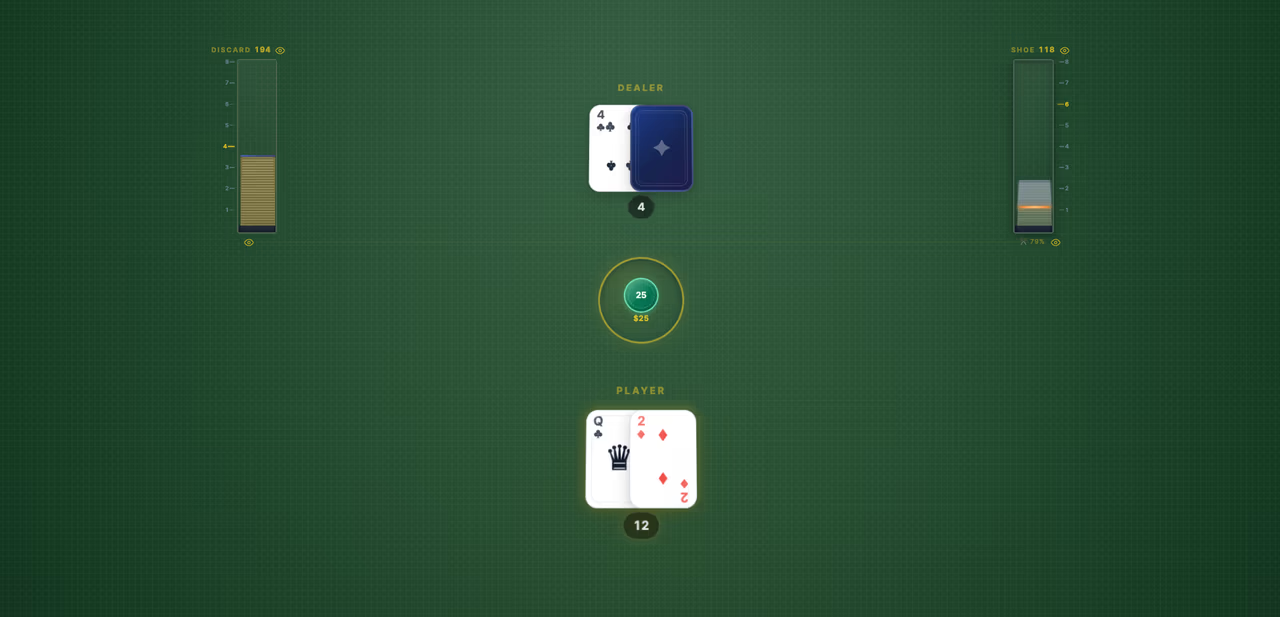
BlackjackPilot: Hit or Stand?
Hit
Stand
BlackjackPilot Blog
Blackjack RTP is usually 99% to 99.6% with perfect basic strategy. Learn how house edge, table rules, and player mistakes affect your real return.
Blackjack RTP is usually between 99% and 99.6%, making it one of the highest-return casino games available. With basic strategy, you keep more of your money than in almost any other game on the floor. Play poorly, and that number drops below 97% — fast.
This guide breaks down exactly what blackjack RTP means, which table rules move it in your favor, and how skilled play can push your personal return above 99%.
Quick Answer: Blackjack RTP is typically 99% to 99.6% with perfect basic strategy. With poor play, it can drop below 97%. Card counters can push their personal RTP above 100%.
Blackjack RTP (Return to Player) is the percentage of total money wagered that a game returns to players over a large sample of bets. It is the mathematical mirror image of house edge:
RTP = 100% − House EdgeExample:
| Metric | Perspective | Typical Blackjack Value |
|---|---|---|
| RTP | Player's return per dollar | 99.0% – 99.6% |
| House Edge | Casino's profit per dollar | 0.4% – 1.0% |
The house edge is how much the casino expects to keep; blackjack RTP is how much players expect to get back. They always sum to 100%.
Blackjack's RTP is driven by two things that most other games lack: player decisions and flexible payouts.
No other table game gives the player this much influence over the outcome. You can practice decisions in the Matchup Simulator to see exactly how each choice affects your return.
Casinos and software providers calculate blackjack RTP by simulating millions of hands with a fixed rule set and perfect strategy. The result is a theoretical RTP tied to those exact rules.
Each rule adds or subtracts a precise percentage point from the base blackjack RTP. They are not guesses — they are solved mathematically.
| Payout | Impact on RTP |
|---|---|
| 3:2 (standard) | Baseline |
| 6:5 | −1.39% |
| Even money | −2.27% |
A 6:5 game with otherwise good rules still has a worse RTP than most roulette wheels. Always play 3:2.
| Decks | House Edge Contribution | Notes |
|---|---|---|
| 1 | ~−0.48% vs 8-deck baseline | Best for player |
| 2 | ~−0.19% vs 8-deck baseline | Good |
| 4 | ~−0.06% vs 8-deck baseline | Minor edge |
| 6 | Near baseline | Common in casinos |
| 8 | Baseline | Most common |
| Rule | RTP Impact |
|---|---|
| Dealer stands on all 17s (S17) | +0.20% vs H17 |
| Dealer hits soft 17 (H17) | −0.20% vs S17 |
| Rule | RTP Impact |
|---|---|
| Double after split (DAS) allowed | +0.14% |
| Re-split aces allowed | +0.06% |
| Late surrender available | +0.08% |
| Early surrender available | +0.24% |
| Double on 9–11 only (restricted) | −0.09% |
| No resplitting | −0.05% |
| Game Variant | Approximate RTP (Perfect Strategy) |
|---|---|
| Single-deck, S17, DAS, 3:2 | ~99.8% |
| Double-deck, S17, DAS, 3:2 | ~99.6% |
| 6-deck, S17, DAS, surrender, 3:2 | ~99.5% |
| 6-deck, H17, DAS, 3:2 | ~99.3% |
| 6-deck, H17, no DAS, 3:2 | ~99.2% |
| 6-deck, H17, 6:5 payout | ~98.0% |
| 8-deck, H17, 6:5, no surrender | ~97.7% |
| Game | RTP |
|---|---|
| Blackjack (basic strategy, good rules) | ~99.5% |
| Craps (Pass Line) | 98.6% |
| Baccarat (Banker bet) | 98.9% |
| European Roulette | 97.3% |
| American Roulette | 94.7% |
| Slots (typical) | 92%–96% |
| Keno | 70%–80% |
Blackjack is in a different league when played correctly.
The published RTP for a blackjack game assumes perfect basic strategy. Your actual RTP is a direct function of how closely you follow that strategy.
| Player Type | Typical House Edge | Effective RTP |
|---|---|---|
| Perfect basic strategy | 0.4%–0.6% | 99.4%–99.6% |
| Minor mistakes | 1%–2% | 98%–99% |
| Average recreational player | 2%–4% | 96%–98% |
| Hunches and guesswork | 5%–7% | 93%–95% |
| Card counter (advantage) | −0.5% to −1.5% | 100.5%–101.5% |
An average recreational player effectively plays a game with a worse RTP than American Roulette — not because the game is unfair, but because suboptimal decisions surrender the built-in advantage. Use the Matchup Simulator to identify and fix your costly mistakes.
Blackjack is the only widely available casino game where a skilled player can achieve a long-term RTP greater than 100% — meaning a mathematical profit edge over the house.
Card counting tracks the ratio of high cards (tens and aces) to low cards remaining in the shoe. When the remaining deck is rich in tens and aces:
The player exploits this by increasing bets when the count is high and decreasing them when the count is low.
| True Count | Player Edge | Effective RTP |
|---|---|---|
| −3 or lower | −2% or worse | ~98% |
| −1 to 0 (neutral) | ~−0.5% | ~99.5% |
| +1 | ~0% (breakeven) | ~100% |
| +2 | ~+0.5% | ~100.5% |
| +3 | ~+1.0% | ~101% |
| +4 | ~+1.5% | ~101.5% |
| +5 or higher | ~+2.0%+ | ~102%+ |
Averaged across all counts throughout a full shoe, a card counter using proper bet spreading typically achieves an overall RTP between 100.5% and 101.5%.
Online blackjack RTP is published by game providers and verified by independent auditors (eCOGRA, iTech Labs, GLI). This makes online RTP more transparent than most land-based casinos.
| Game Type | Typical RTP Range | Notes |
|---|---|---|
| RNG (Random Number Generator) | 99.2%–99.7% | Fastest, best rules often available |
| Live dealer — standard | 99.1%–99.5% | Real cards, real dealer |
| Live dealer — side-bet heavy | 97%–99% | Side bets drag down combined RTP |
| Infinite Blackjack (shared hands) | ~99.5% | Good base rules, check 6:5 vs 3:2 |
| Single-deck online | 99.5%–99.9% | Watch for 6:5 traps |
Key difference from slots: Slot RTP is certified per spin including the machine's fixed math. Blackjack RTP assumes perfect strategy — a number you must earn with correct play.
RTP tells you the long-run average. Variance tells you how wild the ride will be getting there.
| Factor | Impact on Variance |
|---|---|
| Standard hands (hit/stand only) | Low variance |
| Doubling and splitting | Moderate variance increase |
| Side bets added | High variance increase |
| Card counting + bet spread | Higher variance; needs deep bankroll |
A 99.5% blackjack RTP does not mean you win 99.5 cents every hand. It means that over hundreds of thousands of hands, total returns approach 99.5% of total wagers. Short sessions can look very different.
Rule of thumb: The closer your session length is to "all hands you'll ever play in your life," the closer your results will converge to the theoretical RTP.
Not all blackjack games are created equal. Use this checklist before sitting down:
True in aggregate — but individual players absolutely win sessions, and skilled players can generate long-term profit through advantage play. RTP defines averages across all players, not individual outcomes.
No. Each hand is statistically independent (within the same shoe). The game has no memory of your previous results. This is the Gambler's Fallacy.
Not necessarily. Variance describes the distribution of outcomes, not the average. A high-variance game can still have a high RTP — the swings are just larger on the way to that average.
Reputable licensed operators use certified RNG software with audited RTP. Certified online blackjack frequently has better rules — and therefore higher RTP — than many land-based casino floors.
Side bets nearly always have house edges of 4%–15%, dragging your combined session RTP well below the main game's figure. They are entertainment expenses, not strategy tools.
Before every session, run through these steps to maximize your effective RTP:
The best way to internalize how RTP works is to see it hand by hand. Our Matchup Simulator lets you compare decisions in real time and observe how each choice affects your expected return.
Pro Tip: Use the simulator to build an intuitive feel for high-RTP vs low-RTP situations before you encounter them at a real table.
RTP in blackjack is not a fixed marketing number printed on a machine — blackjack RTP is a mathematical outcome you actively shape with every decision you make. A great game with poor play produces a terrible personal RTP. A good game with perfect strategy produces one of the highest player returns in any casino.
Key takeaways:
Know the rules at your table, play every hand correctly, and blackjack's math works with you — not against you.
A good blackjack RTP is 99.3% or higher. This requires a 3:2 payout table and at least basic strategy play. Games offering 99.5%+ (6-deck, S17, DAS, surrender, 3:2) represent the best available conditions for most players.
Yes — 99% RTP is easily achievable for any player who learns basic strategy. The strategy is not complicated to memorize, and free charts are widely available. The main threats to 99%+ RTP are 6:5 payouts and repeated strategy mistakes.
Yes. Card counters who track the deck composition and adjust bet sizes accordingly can achieve a long-term RTP above 100% — meaning a mathematical edge over the house. A true count of +2 or higher typically puts the player into positive expected value territory.
Blackjack RTP (99%–99.6% with basic strategy) is far higher than typical slot RTP (92%–96%). The key difference: blackjack RTP depends on your decisions, while slot RTP is fixed by the machine.
Yes, but less than most players think. Switching from 8 decks to 1 deck improves RTP by roughly 0.5%. Switching from a 6:5 to a 3:2 payout improves RTP by 1.39% — nearly three times more impactful than the number of decks.
The single biggest RTP killer is a 6:5 blackjack payout instead of the standard 3:2, which costs the player 1.39%. After that, a dealer hitting soft 17 costs ~0.2%, and strategy mistakes can cost 1%–5% depending on how often they occur.
To build on the concepts in this guide, check out these related articles: