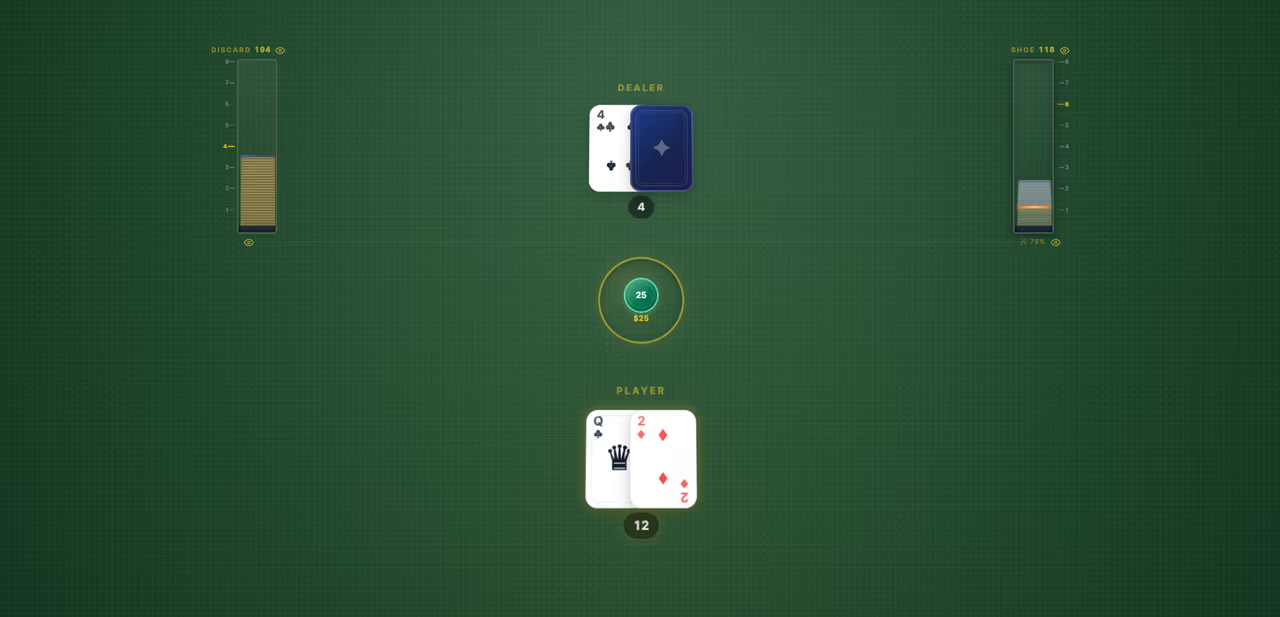
BlackjackPilot: Hit or Stand?
Hit
Stand
BlackjackPilot Blog
Free blackjack surrender chart for late and early surrender. See when to surrender hard 16 vs 10, H17 vs S17 rules, Fab 4 index plays, and drill spots in the strategy trainer.
Surrendering in blackjack feels like quitting—but done correctly, it's one of the sharpest moves in basic strategy. When you surrender, you fold your hand and recover half your bet. That single action, applied to the right situations, shaves a meaningful slice off the house edge. This guide covers every scenario where surrender is mathematically correct, the difference between Late and Early Surrender, and how card counting shifts those thresholds.
Want the essentials immediately? Here's the entire surrender strategy in 60 seconds:
Need the chart first? Open the interactive blackjack strategy guide and enable late surrender to see every surrender spot for your rules — or jump to the complete surrender chart below.
Surrender lets you forfeit your two-card hand in exchange for getting half your bet back. Instead of playing out a hand where you're a significant underdog, you cut your losses immediately.
Example:
Surrendering saves you $2 on this hand compared to hitting. Over hundreds of hands, those $2 increments add up significantly.
The breakeven point for surrender is straightforward:
Surrender when your win probability is less than 25%.
If you win more than 25% of the time, you're better off playing out the hand (hitting or standing). If you win less than 25%, surrendering returns more than playing.
Why 25%?
Late Surrender is the standard version available at most casinos that offer surrender at all. The key word is late: you can only surrender after the dealer checks for blackjack.
Sequence:
Late Surrender is available at many shoe games (6D, 8D) and at some single/double deck tables. Always ask the dealer before your session begins.
Early Surrender lets you fold before the dealer checks for blackjack. Because you can bail out even when the dealer ends up with blackjack, it's dramatically more powerful—and nearly extinct in modern casinos.
Early Surrender reduces the house edge by ~0.24%, roughly three times more than Late Surrender.
If you ever find a game with Early Surrender, use it aggressively:
Extra Early Surrender plays (vs. Ace):
Early Surrender is almost never offered today. Focus on mastering Late Surrender first.
| Your Hand | vs 2 | vs 3 | vs 4 | vs 5 | vs 6 | vs 7 | vs 8 | vs 9 | vs 10 | vs A | | ----------- | :--: | :--: | :--: | :--: | :--: | :--: | :--: | :--: | :---: | :--: | | Hard 16 | — | — | — | — | — | — | — | ✂️ | ✂️ | ✂️ | | Hard 15 | — | — | — | — | — | — | — | — | ✂️ | ✂️ | | Hard 14 | — | — | — | — | — | — | — | — | — | — | | Hard 13 | — | — | — | — | — | — | — | — | — | — |
✂️ = Surrender | — = Play on (Hit or Stand per basic strategy)
Critical note on 8-8: 8+8 = 16, but always split 8-8—never surrender the pair. Splitting 8s vs 10 is a -EV play, but it's still better than surrendering the pair outright.
When the dealer hits soft 17, surrender becomes slightly more aggressive:
| Your Hand | vs 9 | vs 10 | vs A | | ----------- | :--: | :---: | :--: | | Hard 17 | — | — | ✂️ | | Hard 16 | ✂️ | ✂️ | ✂️ | | Hard 15 | — | ✂️ | ✂️ | | Hard 14 | — | — | — |
Hard 17 vs dealer Ace is a surrender in H17 games—this surprises many players. The reasoning: when the dealer hits soft 17, the Ace upcard is more dangerous because the dealer will draw additional cards on soft 17 and reach strong totals more often.
Almost never surrender soft hands. A soft hand cannot bust on the next card, which means the bar for surrender is almost never met. The only debated exception is Soft 15 (A-4) or Soft 16 (A-5) vs dealer Ace in certain H17 games, and even then, hitting is preferred by most strategy engines.
Rule of thumb: If you have an Ace that counts as 11, keep playing.
This is the most important nuance in surrender strategy:
| Pair | Action |
|---|---|
| 8-8 | Always split — never surrender |
| 7-7 | Split vs 2-7; surrender vs 10 (H17), otherwise hit |
| 6-6 | Split vs 2-6 (DAS); hit otherwise — never surrender |
| A-A | Always split — never surrender |
The confusion around 8-8 is common. Hard 16 vs a 10 is the single worst hand in blackjack, but 8-8 gives you an escape route (splitting) that a composed 16 doesn't. Split the 8s.
Understanding the numbers builds confidence. Here are the exact EV values (in units, 6D S17 DAS):
| Action | EV |
|---|---|
| Hit | −0.541 |
| Stand | −0.540 |
| Surrender | −0.500 |
Surrender saves you ~0.04 units per hand. Over 200 hands where this situation arises, that's 8 extra units in your pocket.
| Action | EV |
|---|---|
| Hit | −0.543 |
| Stand | −0.585 |
| Surrender | −0.500 |
Here the gain is larger—don't stand on hard 15 vs 10.
| Action | EV |
|---|---|
| Hit | −0.534 |
| Stand | −0.666 |
| Surrender | −0.500 |
Standing on hard 16 vs Ace is a major mistake. Always surrender if the option is available.
| Action | EV |
|---|---|
| Hit | −0.507 |
| Stand | −0.544 |
| Surrender | −0.500 |
This one is marginal—barely worth it, but still correct per standard 6D basic strategy.
For a deeper dive on EV calculations in blackjack, read our Expected Value guide.
Fewer decks → fewer 10-value cards as a proportion → slightly different break-even points.
| Situation | Single Deck | Double Deck | 6-Deck |
|---|---|---|---|
| Hard 16 vs 10 | Surrender | Surrender | Surrender |
| Hard 15 vs 10 | Surrender | Surrender | Surrender |
| Hard 16 vs 9 | Borderline | Surrender | Surrender |
| Hard 14 vs 10 | Hit | Hit | Hit |
Single deck games are rare and often have other unfavorable rules that offset the deck-count benefit.
As shown in the chart above, H17 games warrant one extra surrender: Hard 17 vs Ace. This trips up many players who learned surrender on S17 tables.
Quick check before each session:
In No Peek (ENHC) games, the dealer doesn't check for blackjack before you act. Surrender is usually not offered in these games. If it is, the rules may specify that surrender against a dealer 10/Ace is void if the dealer turns over blackjack—effectively making it a Late Surrender anyway.
Card counting changes surrender decisions at the edges. The True Count tells you when a hand that's borderline in basic strategy becomes a clear surrender or a clear "play on."
| Situation | Basic Strategy | Surrender if TC ≤ … |
|---|---|---|
| Hard 14 vs 10 | Hit | Surrender at TC ≤ −1 |
| Hard 15 vs 9 | Hit | Surrender at TC ≤ −1 |
| Hard 16 vs 8 | Hit | Surrender at TC ≤ −2 |
| Hard 15 vs A | Surrender | Play on at TC ≥ +2 |
The pattern: At lower true counts, the deck is rich in small cards. Low cards hurt your stiff hands more (more bust outs on the hit, and you can't complete a strong total). Surrender more aggressively in negative shoes.
At high positive counts, 10-rich decks actually make surrender less necessary on some hands—because your hits are more likely to land a 10 and complete a strong hand.
For a complete list of deviations by True Count, see our True Count Deviations guide.
Card counters adjust both bet size and strategy simultaneously. A common mistake is applying positive-count bet sizing but forgetting that the same TC also shifts surrender thresholds:
Surrender is often tucked in a side menu. Look for it before the hand begins. Most RNG online blackjack variants offer Late Surrender. Live dealer tables vary by provider—check the rules section before sitting.
Surrender is less common in hand-held games but does exist. The strategy differences vs 6-deck are minor (mostly affecting Hard 16 vs 9). The bigger impact is that hand-held games often have better rules overall (lower house edge), so the surrender option is doubly valuable.
If you're using BlackjackPilot's hand tracker, the Cashout decision maps to surrender. When you mark a hand as Cashout, the tracker stores it correctly and factors that half-bet recovery into your session EV and bankroll calculations. You can review all surrendered hands in your session history.
Many players who learn about surrender start folding at the first sign of trouble. This is mathematically wrong.
Wrong: Surrendering Hard 13 vs dealer 8 Right: Hit (surrender EV = −0.50; hitting EV = −0.38)
Wrong: Surrendering Hard 16 vs dealer 6 Right: Stand (dealer busts ~42% of the time)
Some players think "always split 8s" means splitting even when surrender is available. The general rule holds — splitting 8-8 is better than surrendering — except in some ENHC games where losing double bets against dealer blackjack makes splitting risky.
In standard Late Surrender games: always split 8-8, regardless of the dealer upcard.
Soft 16 (A-5) vs dealer 10 feels like a losing hand, but your Ace gives you huge flexibility. You can hit without busting, and a 10 converts your soft 16 into a 16 (not great) but a 4 turns it into soft 20 (excellent).
Wrong: Surrendering A-5 vs dealer 10 Right: Hit
Playing Hard 17 vs Ace the same way at every table is a costly habit if you move between S17 and H17 games.
S17 game: Stand on Hard 17 vs Ace (do not surrender) H17 game: Surrender Hard 17 vs Ace
Always check the placard before you sit.
This is the emotional version of mistake #1. Curiosity about outcomes has no place in strategy. If the math says surrender, surrender—even if the next card would have been a 5.
Focus only on clear, unambiguous surrenders to avoid making the wrong call:
These four situations cover the majority of surrender value in a typical session. Get these automatic before adding anything else.
Once the four core surrenders are instinctive, expand to:
At this stage, integrate the TC-based surrender index plays. The impact is small compared to bet-spread deviations, but adds incremental edge in professional-level play.
Priority order for counting surrenders:
Surrender is a verbal declaration in most casinos—there is no standard hand signal. Simply say "Surrender" clearly before you make any other action.
At face-down games (hand-held):
At face-up games (shoe):
Important: Once you touch your chips or make a motion the dealer interprets as another action (hit signal, etc.), surrender may no longer be allowed. Declare first, act second.
Go through 50 flashcard scenarios. For each hand, decide: Surrender? Hit? Stand? Focus on the 4 beginner surrenders until you're instant and error-free.
Practice the same set of scenarios switching between H17 and S17. Specifically drill Hard 17 vs Ace until the rule check is automatic.
Mix surrender scenarios with 8-8 and 7-7 vs strong dealer cards. Force yourself to confirm: "Is this a pair I should split?" before considering surrender.
Use the BlackjackPilot counting trainer and set a side goal: identify every TC ≤ −1 situation that widens your surrender range. Track whether you made the correct deviation each time.
Surrender is available at many casinos and most reputable online platforms, but not universally. Is it worth choosing one casino over another for this single rule?
Yes, if other rules are equal. A casino offering Late Surrender vs one that doesn't gives you an extra ~0.07–0.09% edge. Combined with the stress reduction of avoiding the worst hands, it's a meaningful benefit.
When rules differ, compare:
The overall rule package matters more than any single rule. Use our matchup simulator to compare house edges across different rule combinations.
✅ Confirm the rule: Ask if Late Surrender is available before playing ✅ Hard 16 vs 9/10/A: Surrender (core play — memorize this first) ✅ Hard 15 vs 10/A: Surrender ✅ Hard 17 vs A (H17 only): Surrender ✅ 8-8 vs any card: Always split, never surrender ✅ Soft hands: Almost never surrender ✅ TC ≤ −1: Consider wider surrender range (Hard 14 vs 10, Hard 15 vs 9) ✅ Signal verbally: Say "Surrender" clearly before any other action
Surrender is the most misunderstood option in blackjack. Players either never use it (leaving money on the table) or overuse it (folding perfectly playable hands out of fear). The reality is precise: surrender belongs in a small number of specific, high-disadvantage situations, and everywhere else you play the hand out.
Think of surrender the way a professional thinks about any defensive move: it's not about avoiding risk—it's about optimizing outcome given imperfect information. Hard 16 vs a dealer 10 is going to cost you money. Surrender ensures it costs you less.
Add it to your game systematically: start with the four core surrenders, verify your H17/S17 awareness, and eventually layer in counting-based index plays. Each step reduces variance and tightens your edge.
Ready to practice surrender decisions with instant feedback? Use the basic strategy trainer or compare your reads against the interactive strategy chart.
Related guides: